
Diary Entries
Each week, as we learn about the different pedagogies, I will be trying to keep notes of the content we covered and anything I found important.
Week 1: The Beginning
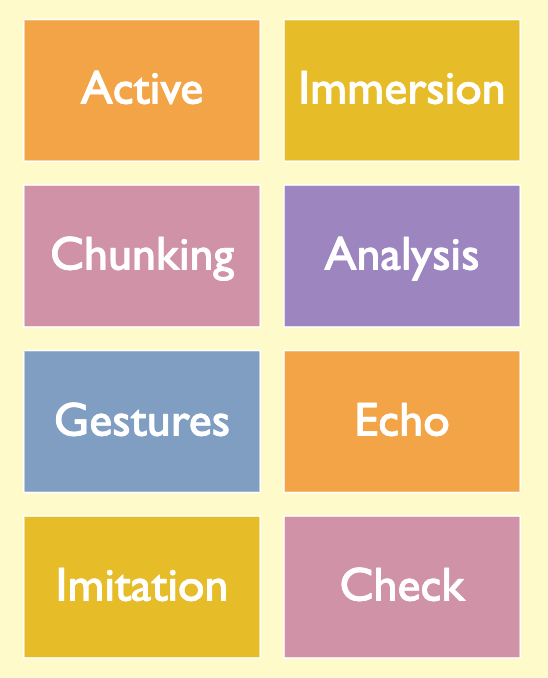
At the beginning of the lesson, we unconventionally started standing up and preparing to sing For Every Voice: A Home, a beautiful piece commissioned and arranged by Astrid Jorgensen specifically for a Queensland choir. This engaging choice set a lively tone for the session, as we connected with the music on a deeper level. Afterward, we delved into a discussion about why we had chosen this approach and explored the significance of implementing an aural-vocal technique in the classroom environment. This method emphasizes the importance of listening and vocalizing as fundamental components of music education. As we progressed towards the latter end of the lesson, Carla skillfully demonstrated how to teach a song by using a comprehensive list of pedagogical tools and techniques. She highlighted various strategies such as incorporating movement, using visual aids, and fostering a supportive atmosphere that encourages participation, which collectively enhance the learning experience for students. This interactive session not only enriched our understanding of music pedagogy but also sparked enthusiasm and creativity among all participants, making it an unforgettable learning experience.
Week 2: Richard Gill
For this week’s reading, we watched Richard Gill’s masterclass on teaching music to kindergarten students, showcasing his skillful conducting of the class through various techniques.
The second video features him explaining to parents the importance of music education, emphasizing that learning music is best through creation. He engages parents in concentration exercises and invites a volunteer to create a new pattern, illustrating the shift from imitation to composition. I think I was impressed with his ability to maintain class control without raising his voice.
As the lesson went on we also learnt about the praxial philosophy of music education. This term was coined by Elliot and Silverman and is given a definition in Chapter 1 (p.52).
“A praxial philosophy of music education emphasises that music should be active reflection and critically reflective action dedicated to supporting and advancing human flourishing and well-being, the ethical care of others and the positive transformation of people’s everyday lives; and that each instance of music should be conceived, taught and learned as a
social praxis – as a fusion of people, processes, production and ethical ‘goods’ in a specific social – cultural contexts.”
We then were told to summarise their definition to make it simpler and more condensed. Out of the different types of summaries our group chose a haiku which goes as follows:
Praxial will teach
You to engage and reflect
music is for all
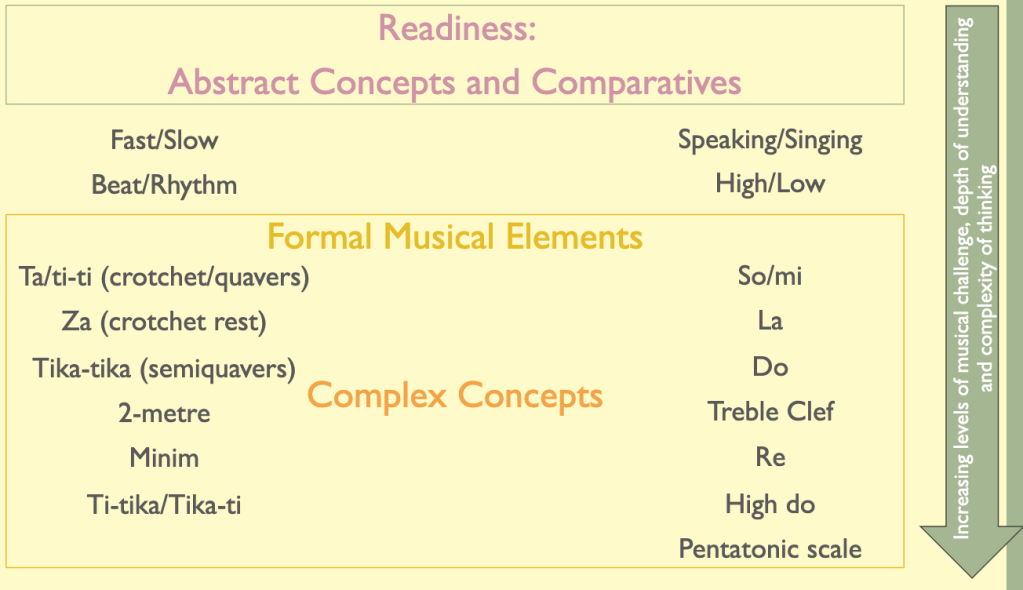
Finally we examined what musical readiness was and how we could apply it to the classroom environment. Musical readiness can be summarised through key points.
•Foundation of musical learning
•Subconscious skill development
•Active engagement and immersion
•Diverse music experiences
•Learning through play
•Aural-vocal approach: sound before symbol
The image below shows the varying degrees of musical “readiness” and how they are translated from simple terms universally understood to proper musical terms.
Week 3: Orff vs Kodaly
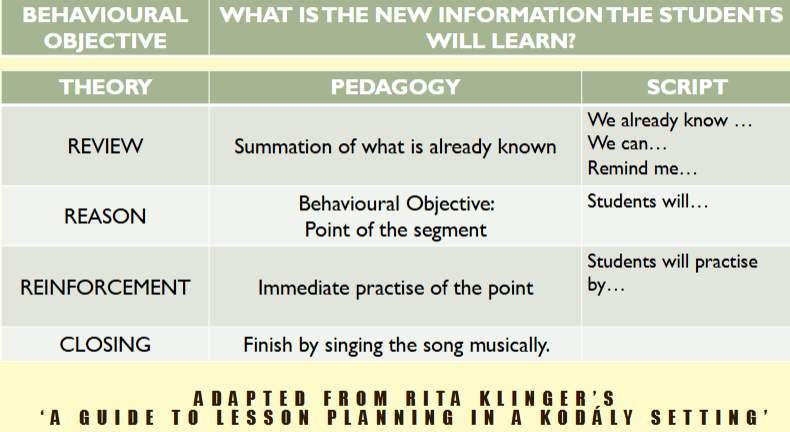
This week we started class (as usual) without any formal introduction or greetings; instead, we stood ready to sing. We sang a song from the Ndebele people of Zimbabwe called Sali Bonani, or good morning in their language. Afterwards, Carla had us reflect on her teaching process, as we would have to do something similar for our assessment 2 later in the semester. I still haven’t chosen my song to teach yet; I have some ideas from previous KIME classes I attended that may help in my song selection. Towards the end of the class, Carla showed us the importance of the Three R’s (+C) in regard to lesson planning.
For this week’s reading we were given a choice between Orff based Music Training Enhances Children’s Manual Dexterity and Bimanual Coordination and secondly, More than Solfege and Hand Signs: Philosophy, Tools , and Lesson Planning in the Authentic Kodaly Classroom. I decided to read the first option which, to summarise, was discussing the results of their “longitudinal training study in communities to examine if collective (Orff-based) music training enhances fine motor abilities, when compared to a homologous training program in sports (basketball), and to no specific training.”1
- Martins, M., Neves, L., Rodrigues, P., Vasconcelos, O., & Castro, S. L. (2018). Orff-Based Music Training Enhances Children’s Manual Dexterity and Bimanual Coordination. Frontiers in Psychology, 9, 2616–2616. https://doi.org/10.3389/fpsyg.2018.02616
↩︎
Week 4: Further into Task 2
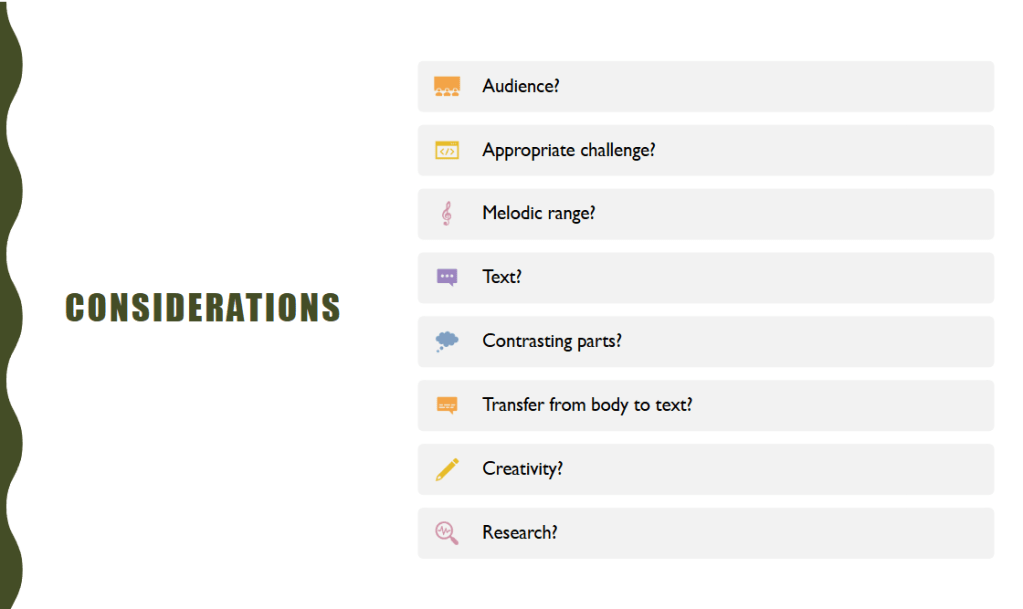
Although I wasn’t able to attend this week’s class in person, through careful examination of the recorded seminar, I was, one, made jealous of the “optional” dancing and singing my fellow classmates were able to do, and two, able to understand the content that I missed, thankfully. This week, Carla showed us some examples of repertoire that could inspire us for our own song that we will be teaching in our next assignment. A useful diagram found within this week’s slides gave us some considerations we should be thinking about before choosing our repertoire.
Week 5: Script Writing + Pizza
Week 5’s seminar was a valuable opportunity for us to revise the comprehensive content we had learned so far, including but of course not limited to: sound before symbol, which lays the foundational understanding of music, musical readiness that ensures individuals are prepared to engage with musical activities, multimodal learning that caters to various learning styles and enhances retention, immersion strategies that encourage deep engagement with music, and praxial philosophy emphasizing the practical application of musical concepts. We also took the time to delve deeper into the difference between an older beginner sequence and a primary sequence, with the obvious distinction being the introduction of more complex musical ideas such as the exploration of homophonic vs. polyphonic textures, which offer rich contrasts in musical compositions, variations in tone color that can evoke different emotions, and the crucial transition from verbal words to solfa notation, and subsequently to musical letter names, which aids in developing a well-rounded musical literacy. This dynamic engagement allowed us to reflect on our progress and identify areas that required further exploration as we continue on our musical journey.
Week 6 Assessment Recap/Musical Element Strategy
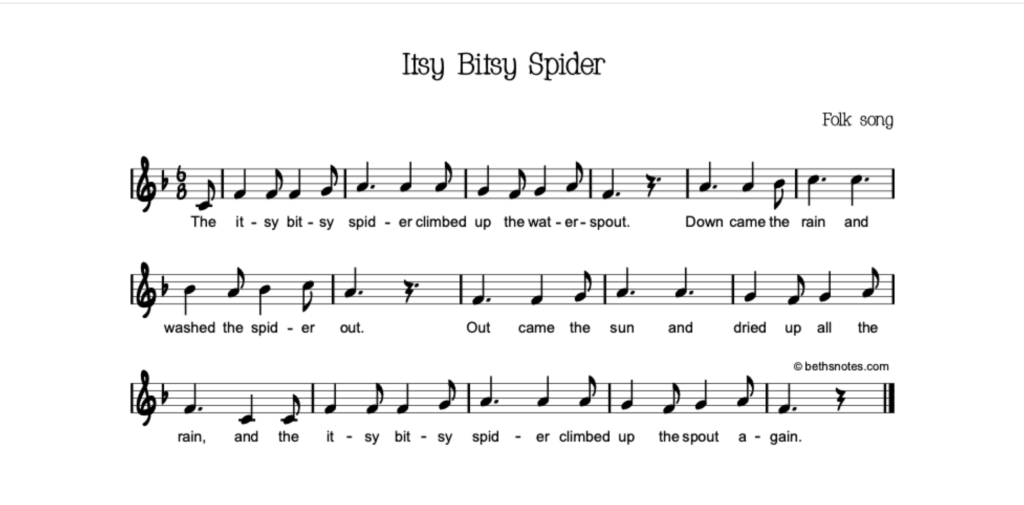
To start off class, instead of our usual singing, we were encouraged to sit down as Carla proceeded to play “In the Hall of the Mountain King” while keeping the beat on our bodies. We proceeded to try and keep up as the tempo increased, so that by the end of it, we were all tired and very stretched out. Carla let us recover for a second, then asked us to think about what age group we would try to pitch an exercise like this to. Some people believed it would be better for stage 4 (year 7-8), whilst I thought, due to its simple nature and it being suitable for small, stretchy kids rather than us joint-rusted adults, stage 2 (year 3-4). After this, we spent the majority of the lesson running over the rest of the content for this semester and were given the opportunity to ask questions about our upcoming video draft in week 8. I have chosen the children’s nursery rhyme “Itsy Bitsy Spider” as the song I will be teaching for my assignment 2. The Itsy Bitsy Spider holds a special place in my musical heart, as it was sung to me by my mother during every rainy day, as well as “Rain, rain, go away.”
Week 7: Strategy for Ta/Ti-Ti
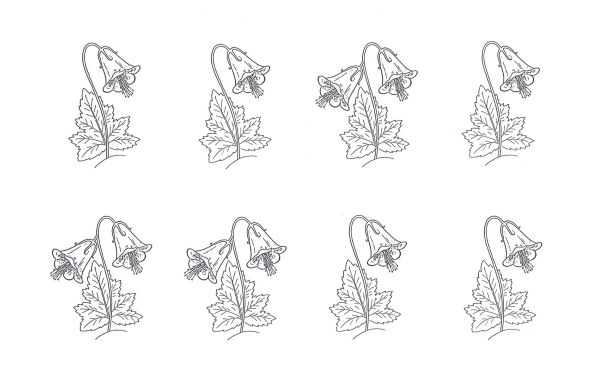
This week we picked up where we left off on the booklet Carla handed out. We got up to how to prepare a visual representation to help our students visualize one or two syllables on a beat in the song ‘Blue Bells’. A simple image of 8 flowers (blue bells) separated into two rows of four helps the kids count along with the music. We saw this in action as Carla showed us some body cam footage of her teaching a lesson at Fort Street Primary School. In the various videos we see how Carla embodies the three P’s: Present, Present, and Practice through careful management of the class and gently moving the children towards the lesson goal. We wrapped up the lesson as usual with any questions about our teaching segment and a reminder for our first draft video to be submitted before the end of week 8. For my draft, I plan to have my partner act as the student whilst I teach her “Itsy Bitsy Spider“.
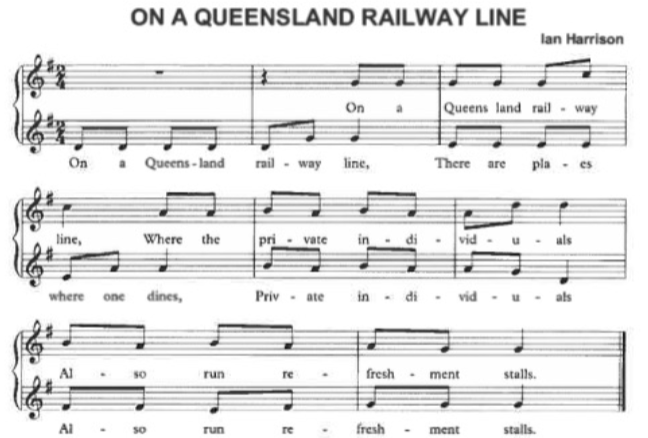
Week 9: Last Practice
After our little break, Carla started off class with a classic new song to learn, this time showcasing a folk song from Queensland about the different stops along the railway. After we learned that, Carla then went into some more specifics about our upcoming teaching segment in week 10. We split up into pairs and practiced teaching our parts to our partners. Then we reflected on what we could have done better and took notes on tips and tricks others discovered. I learned that due to my song choice being quite well-known, I can afford to chunk my piece into smaller segments, while my partner also gave me some feedback on how to teach the different parts of my song more smoothly. See below for one of my first times teaching the song to someone other than my cat.
Week 11: The Big Day
This Friday was the due date for our peer teaching and script, which for me was teaching the Itsy Bitsy Spider for 5 minutes to the class. After standing up and participating in everyone else’s teaching, it finally came around to my turn. Although the video below doesn’t have the best camera angle, the audio tells a different story.
I found the experience very enjoyable and educational, not just from my own teaching segment but also from watching my classmates. Carla encouraged us to write down notes in between each 5-minute song so we could reflect and hopefully have some constructive feedback. At the end of the class, I walked out with a smile and a leap in my step, grateful for the opportunity I had been given and enthusiastic about future opportunities.
Week 12: Eportfolio Revision
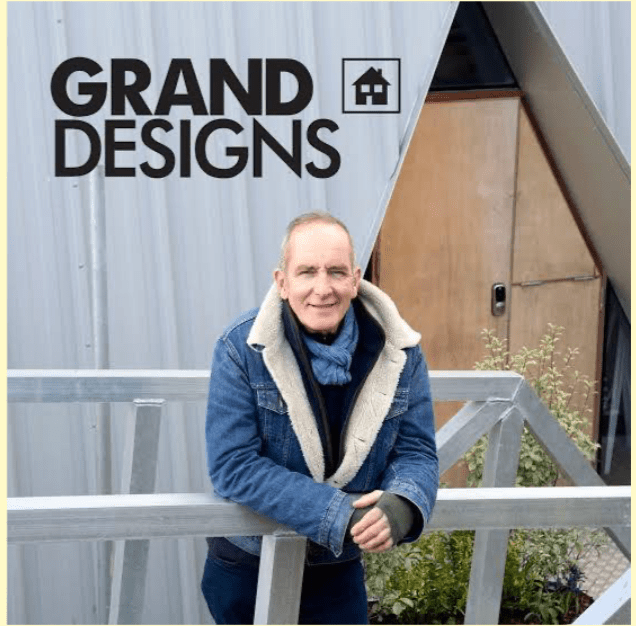
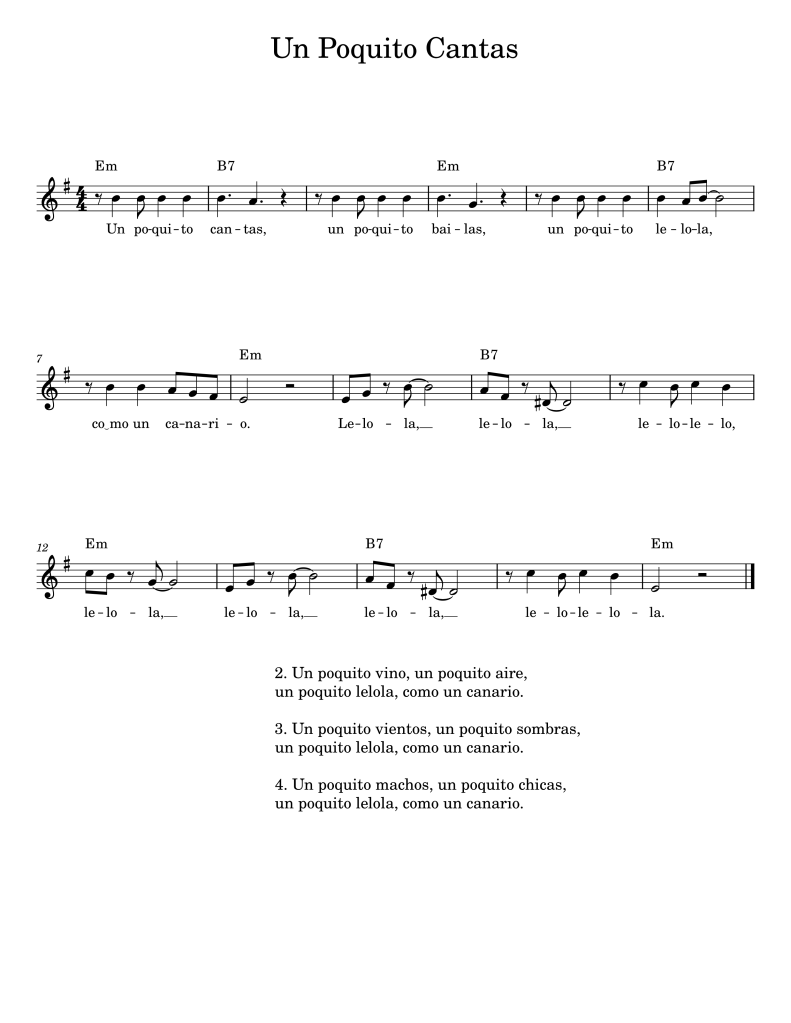
Carla began the lesson with the traditional song “Un Poquito Canta,” featuring challenging body percussion with tapping and snapping. After 5 minutes on the new song, we revised our Eportfolio content. We discussed key aspects of being a music educator, including accessibility, pedagogy, engagement, personhood, and sequential learning. Carla then shared her favorite TV show, “Grand Designs,” which I used to watch with my parents. She encouraged us to consider the similarities between a British TV show and being a music educator through a fun activity where we spoke to a new person and changed partners every 3 minutes. After this, we moved on to the fascinating, albeit not so much, topic of the Australian Curriculum. This is where I came across a dilemma: Carla showed us how to integrate numerical thinking into our music teaching, as it is required by the syllabus. I had the feeling, as we brainstormed about how we could put graphs and equations into a music lesson, that it was somewhat forced. I personally think that by forcing overarching themes across multiple vastly different subjects, music is being dulled to tick off certain boxes decided by bureaucrats without proper musical knowledge.
Week 13: Final Lesson
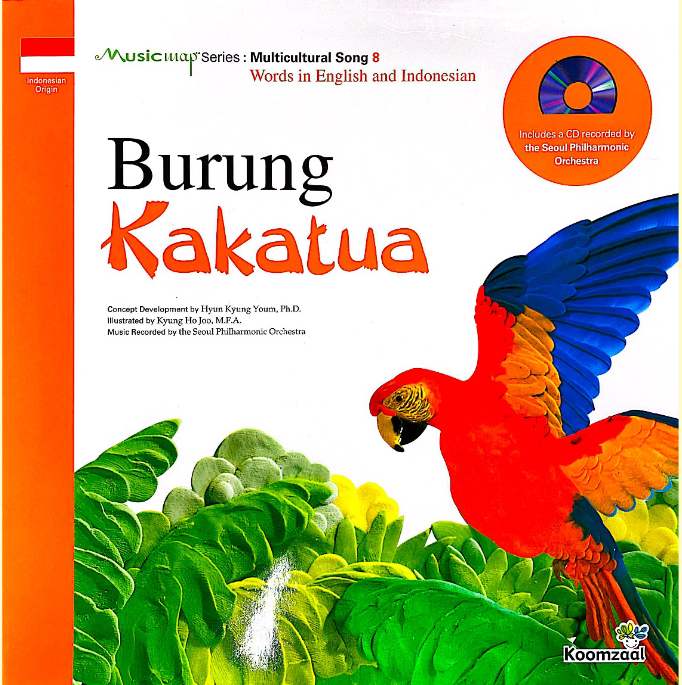
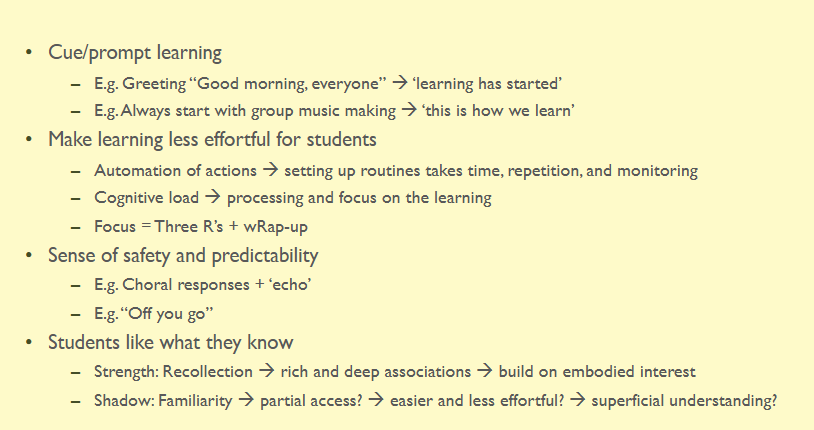
For the final week of KIME, we dissected the repetition of routines in classrooms, such as greetings, roll call, and seating positions, which create safety and predictability while easing learning for students. Carla encouraged discussions about strengths and shadow strengths among peers. When lessons are repetitive, students only partially access topics; varying lesson foci helps broaden their repertoire. After our Mentos break, we explored musical multiliteracies, which simply refer to different ways of sharing music. Notable examples included “On the Queensland Railway Line” and “Burung Kakatua,” before transitioning to songlines. Kim Mahood describes songlines as threads that weave the landscape into a tapestry of places and events, embedding each story component in a song. After watching a video (which can be found here) of an explanation of songlines, we finished the class by discussing our thoughts and queries about songlines, which was a lovely way of wrapping up our final class of the semester.
 Journey Through Music Education